A sloping plot, clay soil that retains water, a south-facing facade that turns the terrace into an oven by June: each outdoor space presents constraints that only a garden design tailored to the specific case can resolve. Starting from a generic plan found online often means redoing the work two years later.
Permeable soil and biotope coefficient: what the local urban plan requires before construction
Before choosing a terrace covering or marking out a path, the local urban planning regulations are checked. In recent years, several metropolitan local urban plans have imposed biotope coefficients or minimum areas of open ground in private gardens.
In practical terms, this means that mineral surfaces (concrete slabs, gravel on geotextile) are limited in proportion to the plot. A customized project incorporates this data right from the site survey, not afterwards.
We still see many “all gravel” gardens designed a few years ago that are now non-compliant with the new rules. Adapting the layout means planning for planting areas, permeable coverings, and hedges that count in the coefficient calculation. This regulatory constraint encourages more vibrant gardens, with more perennials, shrubs, and permeable soils.
By turning to the designs offered by Tradition Jardin, one gains access to concepts that take these local requirements into account from the design phase, avoiding costly revisions.
Outdoor design and summer comfort: the garden as a thermal lever
This role is rarely discussed, but a custom garden design directly contributes to the thermal comfort of the home. Feedback on this point varies according to orientation and region, but the principle remains the same everywhere.
Shading facades and bioclimatic pergolas
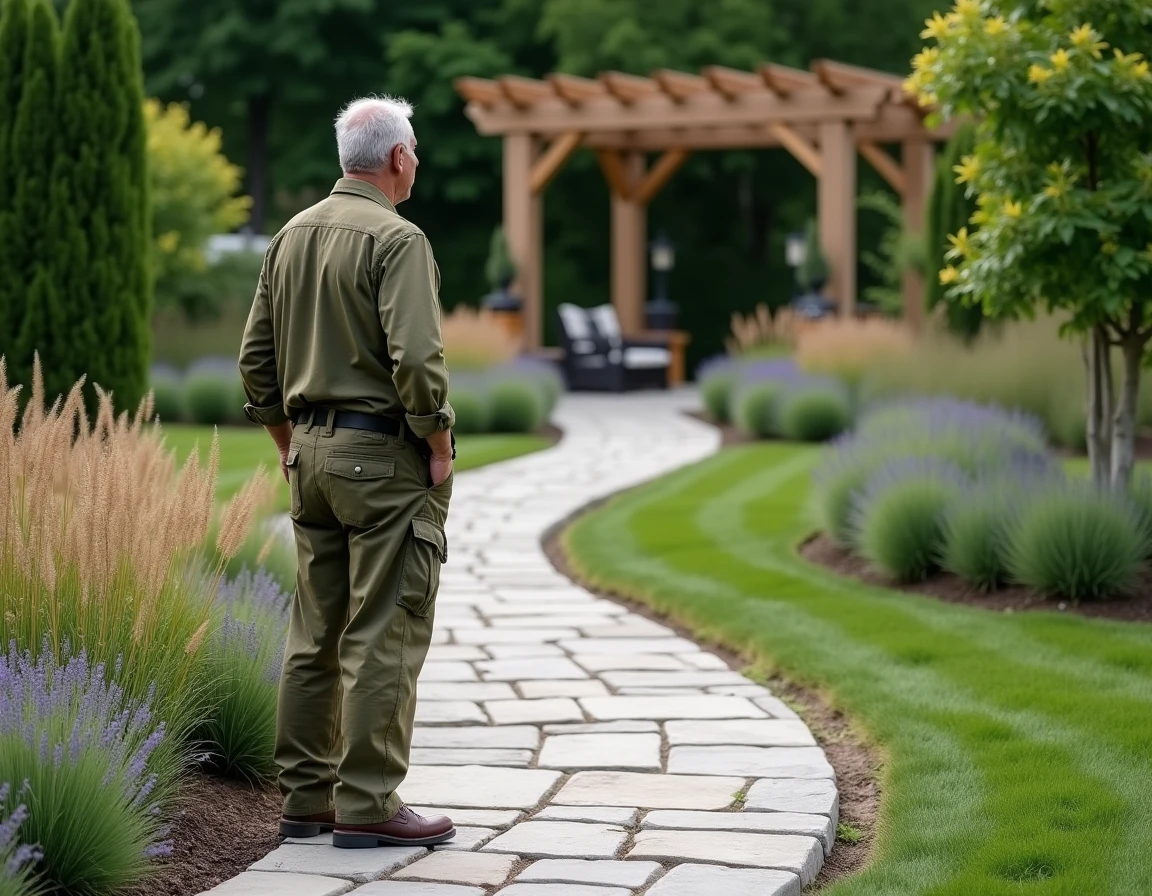
Planting a deciduous tree on the southwest side blocks solar radiation in summer while allowing light to pass through in winter. A bioclimatic pergola with adjustable slats produces the same effect on a terrace.
With the increase in heatwave episodes, the outdoors becomes a lever for summer comfort just like wall insulation. The RE2020 in France encourages addressing the surroundings of buildings to reduce indoor overheating.
Greening near windows
Beds of perennials or climbing plants on trellises installed near large windows lower the perceived temperature inside. The choice of plants depends on exposure: an east-facing wall does not require the same species as a south-facing facade.
A custom design plan positions these greening areas based on the actual sunlight survey of the plot, not on an approximate estimate.
Low carbon materials for garden design: wood, composites, and concrete
The choice of materials weighs heavily on the durability of an outdoor design. There is a growing trend towards low carbon and recycled materials in custom projects.
- Thermo-treated wood certified FSC or PEFC is gradually replacing exotic woods for terraces and borders. Its dimensional stability makes it suitable for variations in soil moisture.
- Recycled composites (a mix of wood fibers and recycled plastic) offer an alternative to traditional decking boards, with reduced maintenance and a long lifespan.
- Low carbon concrete, used for low walls or paving slabs, reduces the project’s footprint without sacrificing strength.
- Borders and furniture made from recycled plastic are gaining ground, supported by labels like the European Ecolabel.
Choosing a material also means anticipating its aging. An untreated wood terrace grays in a few months, while a composite retains its color longer. The right material depends on the soil, exposure, and the maintenance one is willing to undertake.

Custom design: zoning, lighting, and plant selection
A custom garden is not just about laying a terrace and planting a few shrubs. The design begins with a precise zoning of the outdoor space.
Defining usage zones
Functions are separated: dining area, play zone, ornamental beds, vegetable garden, technical passage. Each zone has its constraints regarding soil, shade, and circulation. A frequent passage between the kitchen and the barbecue requires a hard, draining surface, not a lawn that turns into a bog by autumn.
Outdoor lighting suited to the zones
Lighting is not just for decoration. Ground markers along paths prevent falls. Spotlights directed at the beds extend visual enjoyment in the evening without dazzling neighbors. Each light point corresponds to a use, not a fashion statement.
Plant selection according to the terrain
The choice of plants is based on three concrete criteria:
- The nature of the soil (clay, sandy, limestone) determines the species that root properly without permanent amendment.
- Exposure (full sun, partial shade, shade cast by a building) guides the selection towards perennials, grasses, or ferns.
- The desired level of maintenance: annual flowers require renewal each season, while well-chosen perennials come back on their own for years.
A custom planting plan intersects these three parameters for each zone of the garden. The result is an outdoor space that functions without heavy interventions, season after season.
Transforming an outdoor space is not about reproducing a catalog of trends. It is a work of adaptation to the terrain, local rules, and available materials. A custom garden design that integrates these data from the start remains functional and pleasant well beyond the first few years.