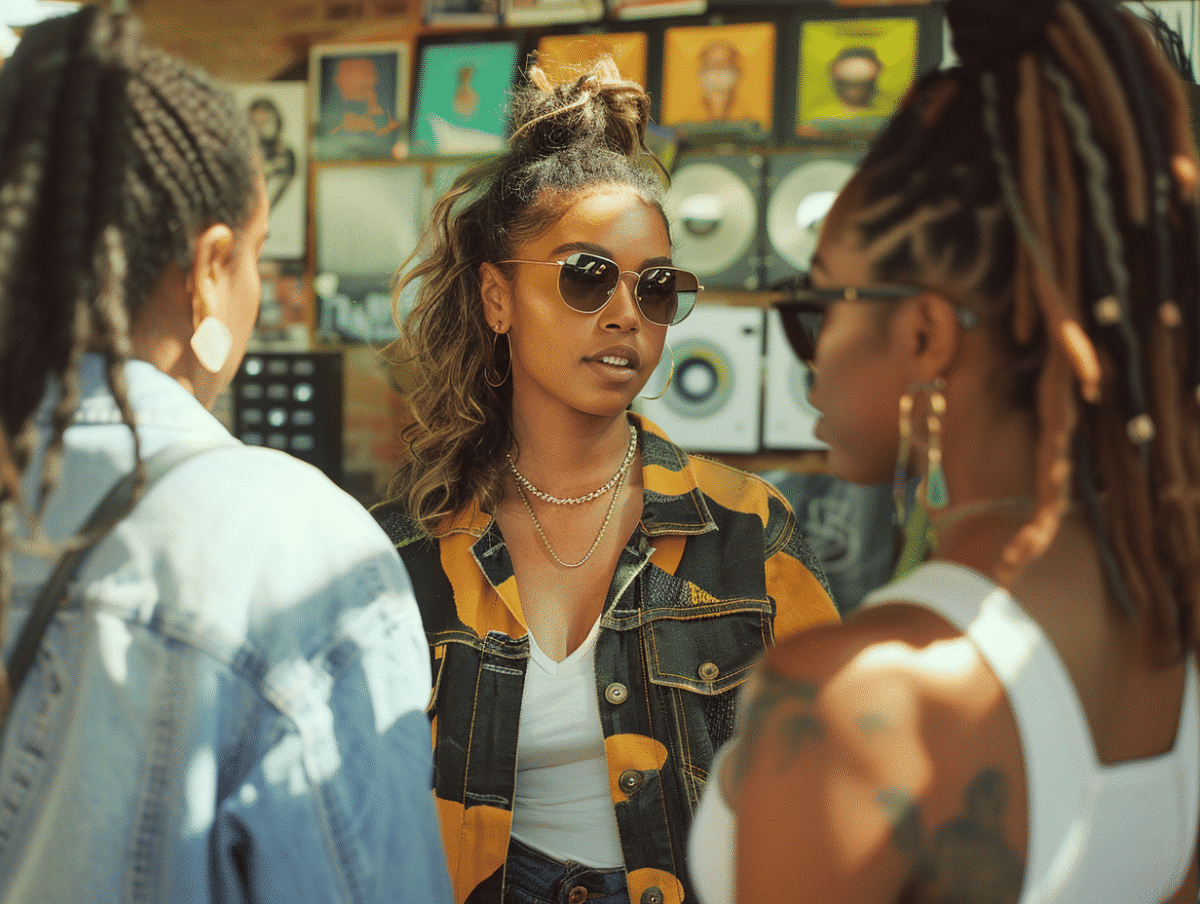
The hip-hop scene has often been perceived as a space dominated by male figures, but over the decades, bold women have broken barriers and established themselves as icons of the genre. From Queen Latifah to Missy Elliott, these pioneers have not only made their mark in the industry through their talent but also through their ability to remain relevant after the peak of their fame. Their post-limelight lives are diverse, extending beyond music to include roles in activism, business, and entertainment, thus redefining the possibilities for future generations of female artists in hip-hop.
Path and Influence: The Lives of Women in Hip-Hop After Fame
Queen Latifah, an iconic figure in hip-hop, has forged a path that transcends the boundaries of music. Awarded for her acting and musical career, she exemplifies constant evolution, remaining active in the industry and diversifying her horizons. Her journey demonstrates a successful transition, where musical fame becomes a springboard to vast creative territories.
MC Lyte, a hip-hop pioneer and the first female rapper nominated for a Grammy Award, continues to exert notable influence. She shows that an artist’s impact is not only measured by their stage presence but also by their engagement outside the studios, influencing generations through her journey and perseverance.
For Lauryn Hill, whose album ‘The Miseducation of Lauryn Hill’ is a classic of the genre, success has not overshadowed her artistic depth. The diamond certification of her work attests to the lasting impact of her music, as well as her ability to inspire, through her life choices and relationship with fame, reflecting on the issues of art and renown.
In the case of Lil Kim, a legend of East Coast rap known for her contributions to hip-hop music, the challenge is one of continuity. How to preserve her legacy while reinventing herself? The answer may lie in her forays into fashion and modeling, illustrating that life after fame can lead to a redefinition of her art. As for Missy Elliott, honored with a star on the Hollywood Walk of Fame, her journey is that of a creator constantly seeking new artistic expressions.
In mentioning these trajectories, let us not forget the new generation, artists such as Nicki Minaj, Cardi B, Megan Thee Stallion, 070 Shake, and Rapsody, who continue to shape the industry. Their successes, whether it be Nicki Minaj’s records, Cardi B’s historic breakthrough on YouTube, or Megan Thee Stallion’s recognition at the Grammy Awards, testify to the vitality and constant evolution of female hip-hop. The albums of 070 Shake and Rapsody resonate as manifestos of the diversity and depth of music created by women in hip-hop.
How can we not mention Kimberly Anne Scott, whose name resonates far beyond her personal ties, as a symbol of these intertwined female destinies with the world of hip-hop. These journeys, these influences, form the fibers of a rich and complex cultural fabric, where life after fame is not an end, but a new beginning.
Impact and Legacy: How These Artists Continue to Shape Hip-Hop Culture
Female rap is not an isolated island in the ocean of music; it constitutes a vibrant domain of hip-hop culture. Female hip-hop artists, through their musical influence, continue to challenge stereotypes, directly addressing stigma and promoting gender equality. Pioneering figures such as Queen Latifah and MC Lyte pave the way for an artistic legacy that transcends the musical sphere, influencing mindsets and social practices.
Sexualization in rap, often criticized, is approached by these artists with a keen awareness. They turn this social phenomenon to their advantage, using it as a tool for empowerment and personal expression. From Lil Kim’s evocative tracks to Cardi B’s iconic performances, female rappers take ownership of their image and narrative, contributing to reshaping the perception of femininity in popular culture.
The notion of positive discrimination also finds its resonance in the hip-hop industry, where initiatives aimed at promoting female talent are multiplying. From awards dedicated to female artists to all-female festivals, these measures help rebalance the presence and recognition of women in a field long dominated by men. The successes of Megan Thee Stallion and Rapsody, for example, illustrate the impact of these changes, both artistically and commercially.
The influence of women in hip-hop continues to expand, weaving connections between music, the fight for gender equality, and the battle against prejudice. The careers of Nicki Minaj, with her chart-topping records, and Missy Elliott, with her legendary contributions to music, demonstrate that the legacy left by these artists is a pillar upon which the new generation relies to continue innovating and enriching hip-hop culture.