
Local security is no longer limited to surveillance cameras and municipal police patrols. French municipalities are facing increasingly diverse threats: local crime, climate risks (heatwaves, sudden floods, suburban fires), and the degradation of public facilities. Responses are also evolving, driven by digital tools and a growing involvement of residents in prevention measures.
Climate Risks and Municipal Safeguard Plans: A Blind Spot That Is Closing
Community safety guides still largely focus on situational prevention, vandalism, or burglaries. However, field reports show that climate risks are reshaping local priorities.
Since 2022, the Ministry of the Interior has observed an increase in updated Municipal Safeguard Plans (PCS) explicitly integrating extreme events. The Ministry of Ecological Transition has documented crisis exercises involving residents, associations, and social landlords at the micro-community level: neighborhoods, condominiums, hamlets.
This evolution changes the very nature of “community safety.” An updated PCS not only protects against a centennial flood. It structures the alert chain, identifies vulnerable individuals, and designates building or street representatives. This human network also serves in normal times to report degradation or assist an isolated neighbor. Additional resources on coordinated security protocols are available at https://www.blueprintforsafety.org/, which documents structured intervention frameworks.
Citizen Participation and Digital Tools: What Field Reports Show
Rennes and Lyon have deployed “public tranquility” applications allowing residents to report incidents or concerning situations in real time. The French Forum for Urban Security (FFSU) and France Urbaine analyzed these systems between 2022 and 2023.
Their findings converge: the use of these tools by residents is significantly increasing, and municipal services are better able to prioritize their interventions on the ground. Neighborhoods equipped with these platforms experience faster processing of reports, which reduces the sense of abandonment often expressed by residents.
Observed Limitations in Deployment
Field reports diverge on one point: the digital divide. Older or more vulnerable populations use these applications infrequently. A 100% digital system risks excluding those who need it most.
Several municipalities compensate with parallel channels: physical offices in town halls, telephone reporting numbers, neighborhood representatives trained to collect alerts in person. An effective reporting system combines digital channels and human relays.
Prevention of Local Crime: Concrete Levers at the Neighborhood Level
Beyond technological tools, community safety relies on prevention actions that do not require massive budgets or technical expertise. Available data do not allow for precise measurement of the impact of each isolated measure, but combined systems produce results documented by local authorities.
- Targeted public lighting in areas of nighttime passage reduces opportunities for crime. Some municipalities have reported a decrease in reports after enhancing lighting in underground parking lots and access to transportation.
- Exploratory walks, where a group of residents walks through a neighborhood to identify trouble spots (dark corners, vegetation obstructing views, degraded street furniture), directly feed into municipal planning.
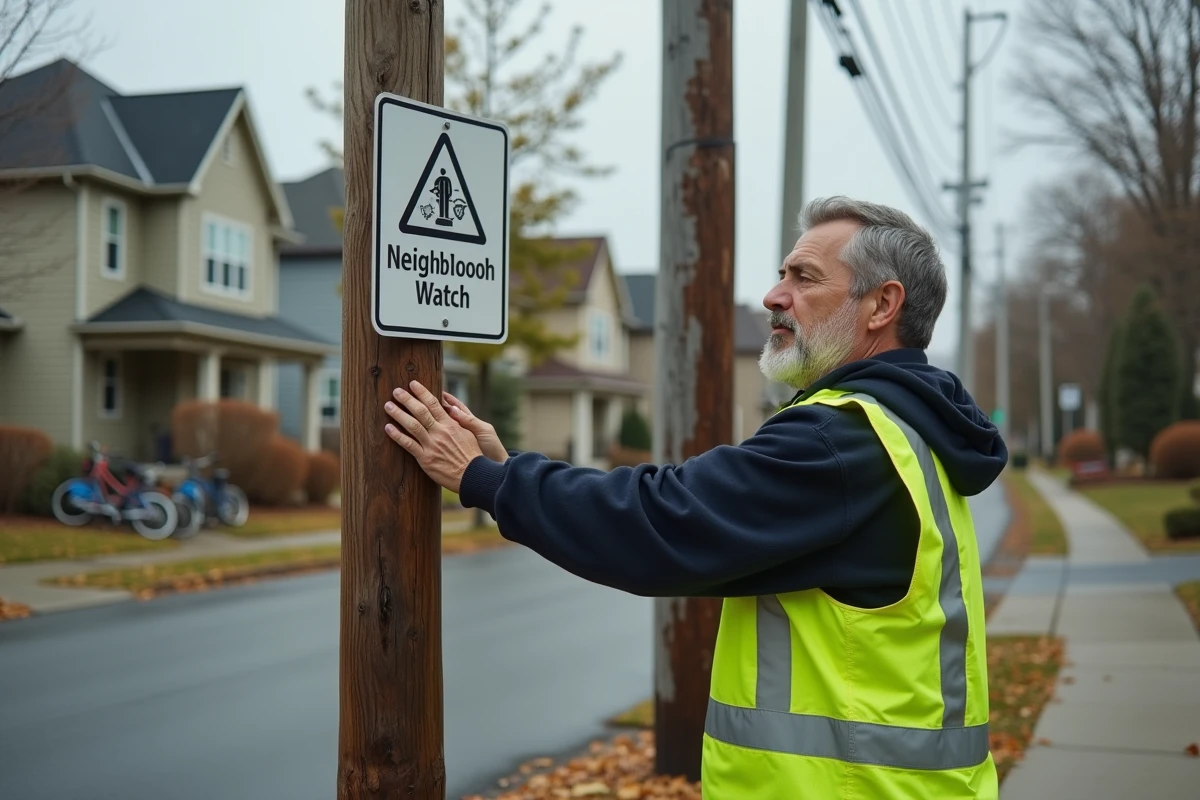
- Neighborhood watch networks, framed by a clear protocol with law enforcement, allow for alert relaying without substituting for the police. Their effectiveness depends on the initial training of participants and follow-up by the municipality.
- Social mediation, provided by trained professionals, addresses neighborhood conflicts, repeated incivilities, or tensions in shared spaces. This lever remains underutilized in mid-sized municipalities.

What Distinguishes an Effective Action from Political Posturing
The difference often lies in continuity. A prevention initiative launched with publicity and then abandoned after six months generates more frustration than the absence of a system. The regularity of follow-up is as important as the quality of the launch.
Municipalities that document their actions (annual reports, indicators of processed reports, participation rates in neighborhood meetings) have a credibility lever with residents. Those that do not struggle to maintain citizen engagement over time.
Community Safety and Inter-Municipal Coordination: A Significant Challenge
Within inter-municipalities, risk management becomes more complicated. Administrative boundaries do not always correspond to living areas. A neighborhood may depend on one municipality for municipal police and another for firefighters or stormwater management.
Coordination between municipalities remains the weak link in local security systems. Information-sharing protocols between neighboring municipal police exist on paper, but their implementation varies significantly from one area to another.
Inter-municipalities that have established shared monitoring cells, bringing together elected officials, law enforcement, landlords, and associations, achieve better results in managing specific crises. However, daily prevention remains driven by the municipal level, which is closer to the ground.
Improving security in a community is not just a catalog of technical measures. The determining factor remains the ability of local actors to maintain a system over time, document its effects, and adjust priorities when the context changes, whether due to a climate event or a shift in local crime.