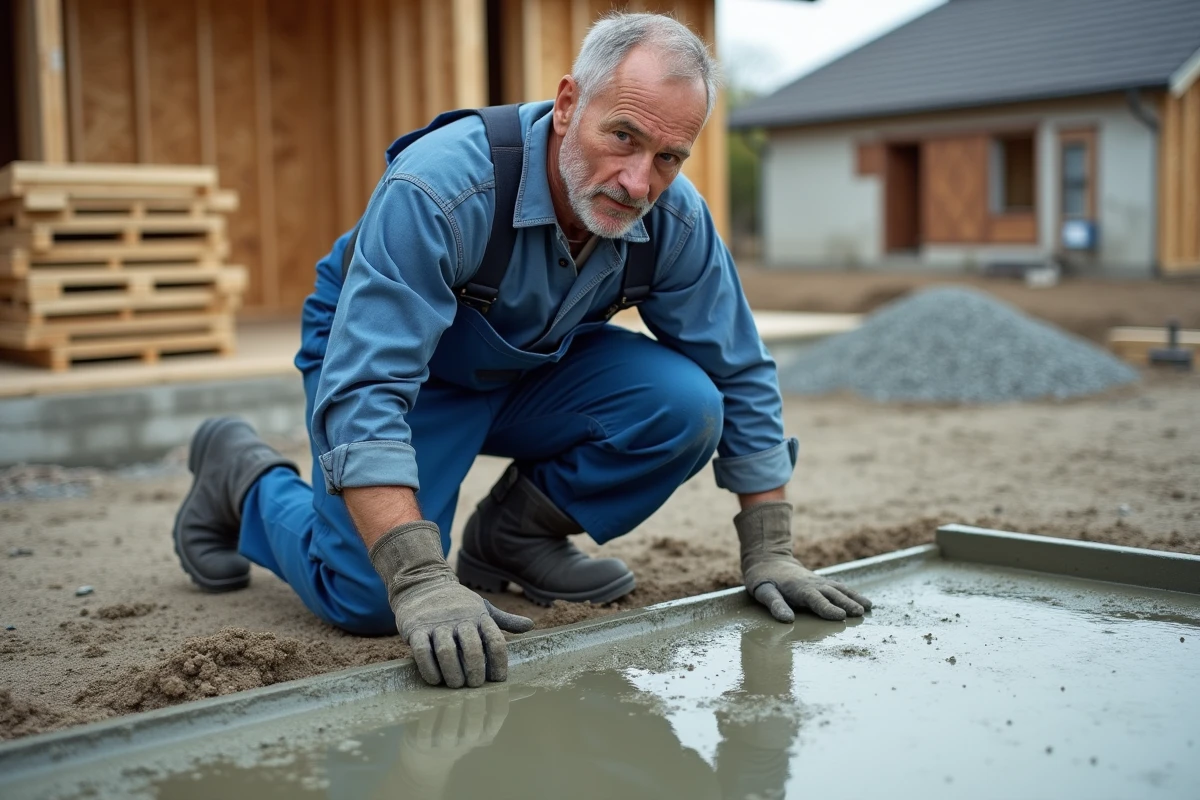
The tax administration did not wait for the construction of walls to take an interest in your concrete slab. A simple rectangle poured on the ground, without a roof or partition, can be enough to attract the attention of the tax authorities as soon as it permanently alters the appearance of your land. Failing to declare is risking new figures appearing on your local tax notice, sometimes much sooner than one might think.
Concrete slab and taxation: what really changes in 2024
The tax landscape surrounding concrete slabs is undergoing a clear transformation. The criteria are becoming more precise: now, a slab, even without a cover, can fall within the scope of the development tax or the property tax. It will depend on the surface area, the intended use, and the connection to the existing structure. The concept of taxable surface area is gaining importance: if a concrete platform serves as a base for a garden shed, or if it extends the living space, the tax authorities will take it into account in the calculation of local taxes.
The construction sector is observing an intensification of checks. Forgetting the prior declaration for a slab of a few square meters is no longer trivial. Retroactive regularizations are multiplying, and the administration no longer overlooks inaccuracies. Everyone must report any project that could modify the cadastral value of the property, even for a slab simply laid on the ground or intended to accommodate a small shed.
To navigate this, one must know the new criteria used in 2024:
- Surface area: any slab exceeding 5 m² may be subject to taxation.
- Purpose: slab designed to accommodate a construction, such as a garage or garden shed.
- Stability and durability: the structure must be permanently fixed to the ground.
Here are the main elements that the tax administration is considering this year:
Owners eager for information will find detailed analyses on everything you need to know about taxable concrete slabs in the file “Taxation of a slab: what you need to know – Banking and Finance.” The time for approximation is over: local taxation is now part of every project. In 2024, the concrete slab changes status and becomes an essential topic for anyone modifying their land.
Declaration of a concrete terrace: procedures, pitfalls, and tips to not forget anything
Starting the construction of a concrete terrace means accepting to enter an administrative process where every detail counts. From the first scoop, the prior declaration becomes mandatory. The rule is clear: any surface created from 5 m² must be declared to the town hall. The Cerfa form 13703*07, available online, must be completed and submitted before starting the work. This new space adds to the existing built area and increases the tax bill, square meter by square meter.
The public service requires precise documents: a site plan, a rigorous description of the project, and the exact dimensions. The slightest error can trigger a request for regularization. The classic unpleasant surprise? Forgetting a canopy, a staircase, or a low wall: these annexes, however discreet, are included in the calculation of the development tax and the property tax.
To navigate this process smoothly, several reflexes should be adopted:
- Keep all plans, photos, and supporting documents before making the declaration.
- Consult the local tax administration to know the specific rules for your municipality.
- Remember to declare the completion of the work within 90 days to allow for the update of the cadastral records.
Here are some tips to secure your file:
Opting for transparency limits the risks of reassessment. In case of doubt about the surface to declare or the amount of the tax, the urban planning department agents remain the best recourse. This reflex is especially useful if the terrace enhances a property intended for rental or resale: the income declaration can also be impacted. When facing local taxation, it is better to proceed on well-marked ground.

What impacts on your taxes? Answers to the questions everyone is asking
Whether in Paris or in a rural municipality, the concrete slab no longer goes unnoticed by the tax authorities. Every added square meter affects the property tax. Once the declaration is recorded and the cadastral records updated, the cadastral rental value takes this extension into account and modifies the amount to be paid the following year.
As for the development tax, it is back in the spotlight: any created or transformed surface, beyond the minimum threshold, is subject to it. Its calculation is based on a rate per square meter, adjusted by the municipal rate, which is sometimes increased. In 2024, several municipalities have modified their scale to meet their budgetary needs. The concrete slab, just like the garden shed, must be included on the form to be submitted, under penalty of regularization.
The question of the income declaration still raises hesitations: does investing in a concrete slab entitle one to a tax advantage? In 2024, only energy renovation works allow for a tax credit or a deduction. Outside of insulation or improvement of energy performance, the creation of a slab does not grant a tax reduction, unlike certain schemes that support ecological transition.
For second homes, the housing tax remains in effect in many municipalities, and any addition of surface area can increase the bill. The figures collected this year illustrate the state’s desire to integrate every development project into the local tax base. The rules have never been clearer: every declared surface, every taxed surface. Wanting to expand also means accepting that the tax authorities will join the construction site.