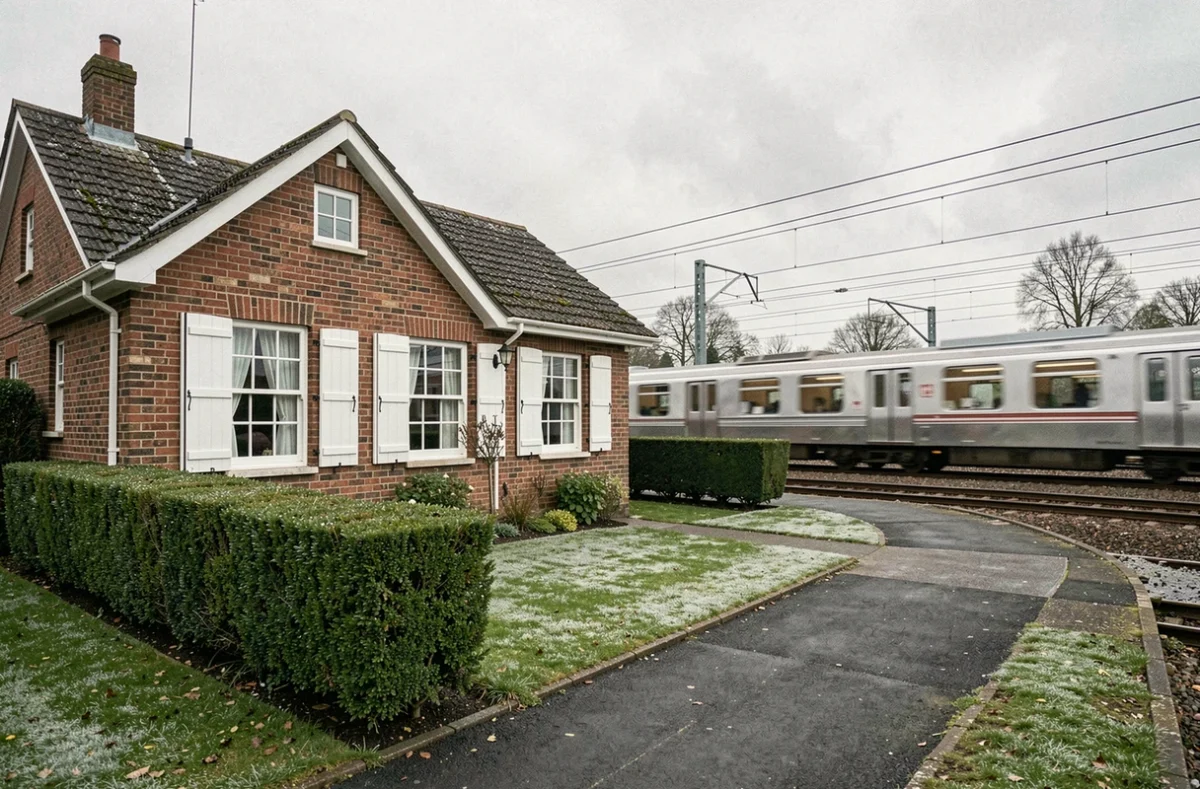
A house priced well below the neighborhood average, a train station just a few minutes’ walk away, and yet few viewings. It’s a familiar scenario for homes near railway lines. The discount can represent a real opportunity, provided you know exactly what you’re buying. The noise you hear in a ground-floor living room is nothing like what you might hear in a second-floor bedroom facing the tracks.
Actual noise exposure: how it varies by room, floor and train type
The usual question is how far the house is from the railway line. That’s not enough. Two homes the same distance from the tracks can offer very different levels of comfort.
A noise barrier (wall or embankment) mainly protects the rooms behind it. According to information attributed to SNCF Réseau, upper floors with a clear view of the tracks above the barrier benefit much less. In practical terms, a ground-floor living room shielded by an embankment may stay quiet, while a first-floor bedroom facing the tracks takes in the sound of passing trains without any buffer.
The type of rail traffic matters too. A regional TER line with a few trains an hour is not as disruptive as a freight route that operates at night. And noise doesn’t come only from moving trains. Near a station, stationary trains generate noise from their ventilation, air conditioning and idling engines. This constant background noise often goes unnoticed during a quick daytime viewing.
When exploring the advantages of a house near a railway line, the location of the main living areas in relation to the tracks deserves just as much attention as the price per square metre.

How to test for noise before buying
A single viewing gives you only a snapshot. The Agence Qualité Construction notes that noise may be considered abnormal when it stands out clearly from the background noise and occurs repeatedly, even if regulatory requirements are met. Compliance with acoustic standards does not guarantee that you won’t experience noise disturbance.
Found a property you like? Visit at least three times, at different times of day.
- In the evening, around 10 p.m., to assess noise levels at bedtime. Some lines carry freight trains at night, and maintenance work is sometimes scheduled overnight—a detail rarely mentioned in listings.
- On a weekday in mid-morning, when passenger traffic is running at its usual pace. Open the windows in every room, especially those facing the tracks.
- In the late afternoon, between 5 and 7 p.m., to gauge how often trains pass during rush hour and check whether vibrations travel through the building’s structure.
Also check whether your local authority publishes noise maps. Some municipalities distinguish between daytime and nighttime railway noise, as well as exceedances of limit values, on a municipality-by-municipality basis. The La Rochelle urban area provides this type of mapping for several municipalities, including Sainte-Soulle and Clavette. Look for the equivalent for the municipality where the property is located before signing anything.
Property discount and purchase price: how proximity can help you negotiate
The main financial advantage of a house near a railway line is the discount. It depends on several factors: train frequency, distance from the tracks and the quality of the building’s sound insulation.
This discount gives you real room to negotiate the purchase price. The money saved can go directly toward soundproofing work: upgraded double glazing, acoustic air inlets and additional insulation on walls facing the tracks. Once soundproofed, the property can offer comfort closer to that of a typical home, while still having cost less to buy.
Being close to a station can also boost a property’s value. A home just a few minutes’ walk from a well-served station has a transport advantage that appeals to commuters, students and rental investors. The balance between noise disturbance and accessibility determines the property’s true value.

Everyday benefits: mobility, budget and quality of life
Beyond the purchase price, living near a well-served railway line can change how you get around. Relying less on a car means saving on fuel, insurance and maintenance. For a household that uses the train every day, those savings add up considerably over several years.
Neighborhoods near stations often have a wider range of shops and services. Bakeries, pharmacies and post offices tend to follow the flow of passengers. This network of local amenities makes everyday life easier without needing to drive.
One less obvious benefit: areas alongside railway lines sometimes include green spaces or greenways developed by local authorities along railway land. These planted strips, partly designed as noise buffers, can also provide pleasant walking and cycling routes for everyday use.
Selling a house near a railway line: anticipate how buyers will perceive it
Resale is the main concern for hesitant buyers. A property near the tracks often takes longer to sell because the pool of potential buyers is smaller. But a longer wait doesn’t necessarily mean a financial loss.
A well-prepared sales file can make all the difference. Providing the results of an acoustic assessment, invoices for soundproofing work and local noise maps reassures buyers far more than a simple verbal claim. Showing that the noise has been measured and addressed turns a perceived drawback into a resolved issue.
The local property market also plays a part. In high-demand areas where demand exceeds supply, the discount associated with a railway line tends to shrink. An apartment near an RER station in the inner suburbs won’t sell at the same pace as a detached house beside a rural freight line.
Buying near a railway line is a personal trade-off between budget, noise comfort and mobility. The tools are available to assess the actual disturbance objectively. The key is to use them before signing, not afterward.