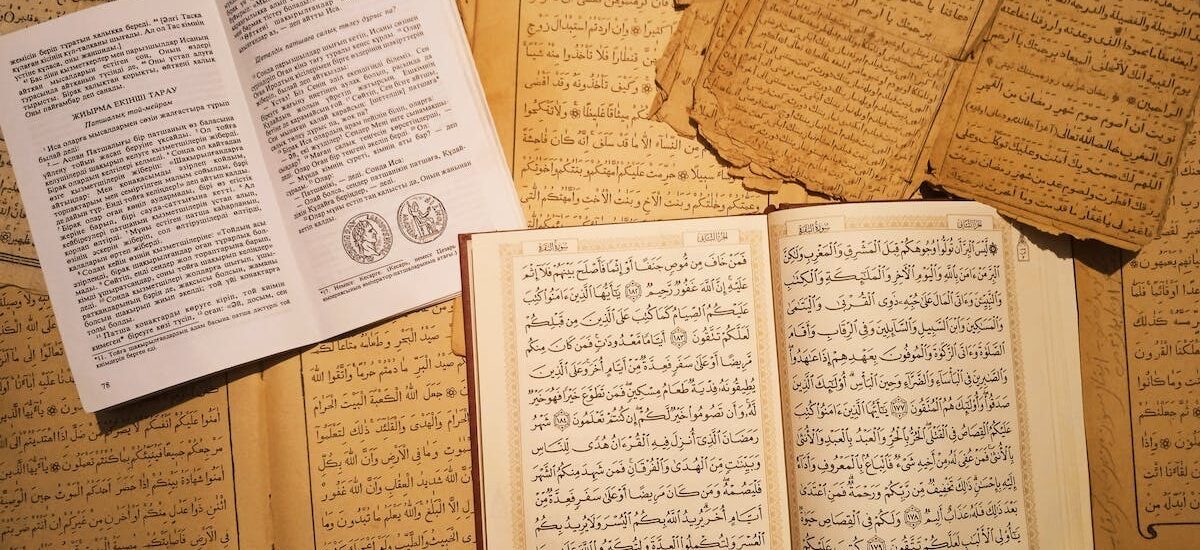
Let’s dive into the twists and turns of history to explore the roots of the Quran, a sacred book that has shaped entire civilizations. Designed as a divine revelation by the prophet Muhammad, its genesis and propagation have sparked heated debates among scholars. This journey through time offers us the opportunity to study the circumstances of its creation and how it has been transmitted through the centuries. A veil of eternity envelops this work, making its quest for origin both fascinating and complex.
Pre-Islamic Origins of the Quran: A Complex Heritage
The life of Muhammad, founding prophet of Islam, is of paramount importance in the transmission of the Quran. His role as a mediator between God and men is undeniably linked to this sacred work. You must approach the sensitive question that still stirs minds with caution: who wrote the Quran?
According to historical accounts, Muhammad received these divine words directly through a series of revelations over a period of twenty-three years. He is considered illiterate and therefore could not write the Quranic verses himself.
The influence of Muhammad on the transmission of the Quran is undeniable. As a spiritual leader and guide of the early Muslims, he played a crucial role in its compilation and recording. Faithful scribes were tasked with scrupulously writing down every word spoken by the Prophet during the moments he recited the Quran before his disciples.
It is also important to note that several versions of the Quran exist today. These divergences can be attributed to the different compilations made after Muhammad’s death. An official version was eventually adopted under the caliphate of Uthman Ibn Affan to standardize the Quranic text.
Questions regarding the exact author of the Quran remain contentious to this day. Some researchers hypothesize that certain passages may have been added or modified after Muhammad’s death.
The transmission of the Quran relies on two pillars: orality and writing. During the early days of Islam, oral recitation played a predominant role in its preservation and learning. Disciples faithfully memorized each verse to pass it on to future generations.
Gradually, to avoid any alteration or loss of the divine teachings, a written form of the Quran was developed. Manuscripts were collected and compiled to ensure a lasting preservation of this divine word.
Even today, the Quran remains at the heart of Muslim life. Considered an infallible moral and spiritual guide, it influences all aspects of their existence: from religious worship to social values to Islamic jurisprudence.
The study of the origins of the Quran is a complex field where history, theology, and linguistics intertwine. While much remains to be discovered about this millennia-old work that has withstood the test of time, it continues to exert undeniable fascination on those interested in its mysterious journey.

Muhammad as the Transmitter of the Quran: A Key Figure in Islam
In the search for the origins of the Quran, consider various factors, such as dialectical differences and the individual interpretation of the scribes tasked with transcribing the sacred text.
One of the first compilations of the Quran was made under the caliphate of Uthman Ibn Affan. He ordered the creation of a single copy to avoid any confusion and divergence among the multiple copies that were beginning to circulate among the nascent Muslim communities. This standard version was based on a specific dialect, that of Quraysh, the tribe to which Muhammad himself belonged.
The Multiple Versions of the Quran: A Complex Compilation Process
The origins of the Quran are surrounded by controversies and intense debates regarding its author. For centuries, researchers have pondered whether the sacred text is a divine creation or the human work of a specific individual.
One of the main controversies revolves around the person of Muhammad himself, regarded by Muslims as the last prophet and the revealed author of the Quran. Some critics question this attribution, arguing that Muhammad was illiterate and therefore incapable of writing a text as complex and elaborate as the Quran. Others challenge his ability to gather the various surahs (chapters) in a specific order to form a coherent book.
Another controversy concerns the oral transmission of the Quran over the generations prior to its official written compilation under Uthman Ibn Affan. Some argue that human memory is unreliable and that it is unlikely the text was transmitted accurately for several decades before being fixed in writing. They also point out the dialectical variations that could have influenced the correct pronunciation of the Quranic verses.
Alongside these questions, there are also alternative theories regarding the presumed authors of the Quran. Some researchers have suggested that it was rather the collective work of many close disciples of Muhammad that led to its final composition. Others hypothesize that certain passages may have been added later by Muhammad’s political successors to serve their own interests.
It should be noted that these theories and speculations remain widely discussed in academic circles. Muslims continue to firmly believe in the divine origin of the Quran and consider Muhammad as its revealed author.
However, the controversies surrounding the author of the Quran remain a complex and delicate subject to address. Research on this theme continues in order to provide further clarifications on the origin of this sacred text that constitutes the cornerstone of the Islamic faith.
From Oral Tradition to Writing: The Transmission of the Quran
The influence of the Quran in the lives of Muslims to this day is undeniable. This holy book occupies a central place in the spirituality and daily life of millions of believers around the world.
The Quran guides Muslims in all aspects of their existence, both individually and collectively. It serves as a source of ethical, moral, and legal guidelines that shape the behavior of the faithful.
On an individual level, regular reading of the Quran is considered a means to achieve spiritual fulfillment. Muslims seek to understand the divine teachings contained in this sacred text in order to improve their relationship with God and to live in harmony with themselves and others.
Beyond the personal sphere, the Quran also exerts a significant influence on Muslim society. Its main teachings are integrated into Islamic legal systems and serve as a legal foundation for governing various social domains such as marriage, inheritance, and commercial transactions. Islamic law, or Sharia, relies heavily on Quranic verses to guide judicial decisions.
The Quran also inspires Islamic art in all its forms, both literary and artistic. Contemporary poets find inspiration in its verses for their poetic creations, while calligraphies adorning mosques often use excerpts from the holy book to illustrate Islamic aesthetics.
The Quran plays a central and omnipresent role in the lives of Muslims. Its reading, study, and understanding are considered essential practices for believers who seek to live according to the main teachings of Islam. Over the centuries, this holy book has managed to transcend cultural and linguistic boundaries to offer a source of universal inspiration to the faithful around the world.
The Quran: A Timeless Influence on the Lives of Muslims
The influence of the Quran manifests not only in the religious life of Muslims but also in various cultural and social domains. Its reach transcends temporal and geographical boundaries, making it a true universal phenomenon.
The Quran holds a prominent place in the daily lives of believers. Beyond its spiritual dimension, this sacred text is also a vehicle for education and knowledge. Numerous Quranic schools exist throughout the Muslim world to teach children how to read and interpret the holy book.
In parallel, the Quran has profoundly influenced Islamic architecture. The mosques that dot urban or rural landscapes testify to this remarkable influence. Most display calligraphic motifs taken from Quranic verses on their walls or domes, thus creating a symbiosis between spirituality and aesthetics.